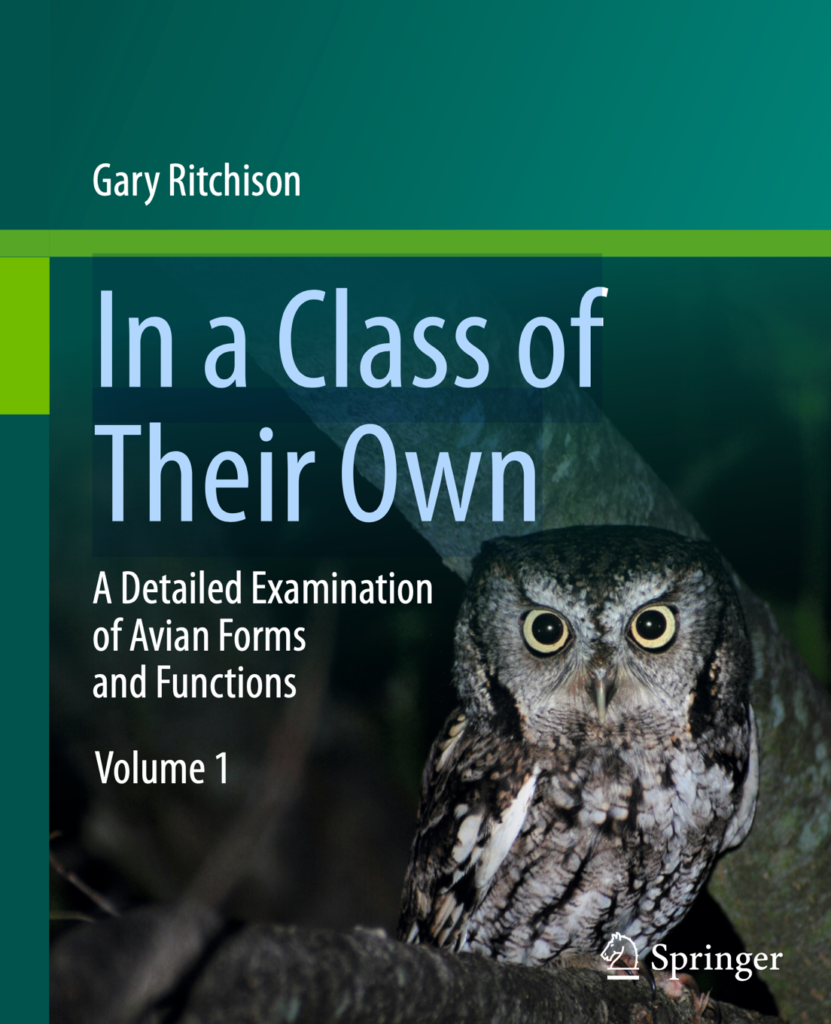
In a Class of Their Own: A Detailed Examination of Avian Forms and Functions. By Gary Ritchison. 2024. Switzerland: Springer Cham. $129.00 (three volume hardcover). ISBN 978-3-031-14851-4. $129.00 (ebook). ISBN 978-3-031-14852-1.
How do you review a book whose title you do not agree with? Birds, however wonderful and unique, are but a specialized lineage of reptiles, well-nested amongst other, now extinct dinosaurs. As such, they ought not to be in a class of their own. Yet, they most certainly deserve the thousands of pages of writing, images, diagrams, figures, and citations that Prof. Gary Ritchison has put together for this fantastic book. These 3 volumes by the long-term former editor-in-chief of the Journal of Field Ornithology, are truly a force-de-tour of an ornithological expert, aimed at those of us who study, love, or otherwise admire all the birds in the world, present and past. This emphasis on both extinct birds and their extinct ancestors are especially strong in the evolutionary and the anatomical chapters that start the book, although fossil dinosaurs also feature in other contexts, such as in the chapter on nest-building and incubation behaviors.
When it comes to the rest of these ~2500 pages of comprehensive and integrative exploration of birds as highly specialized biological systems, the book systematically examines how their forms and functions are consistently and tightly linked—from skeletal structures, musculature, and feathers to highly adapted physiological systems including respiration, metabolism, circulation, and endocrine control both within and outside the avian body (i.e., in ovo). A focal
theme is the extraordinary adaptations of birds to ecological and energetic challenges faced by them, particularly in flying, high-temperature thermoregulation, escaping from predators, and migration. Though the first half of the chapters are anatomically and physiologically themed, even within these chapters is equally important the author’s treatment of bird behavior, ecology, and life history. Across the latter, more behaviorally focused chapters, the book continues to underscore phenotypic flexibility, ecological diversity, and the interplay between anatomy, physiology, and behavioral adaptations as a key for avian success across all the continents of our globe. As we, ornithologists, so well knew, the book re/presents birds as model systems for studying both life history evolution and functional biology: from molecules and organs to behavior and local and global population patterns. I would have liked to see a dedicated section to conservation biology, including conservation physiology and behavior, for which studies on birds have become truly ground breaking.
As a researcher of obligate avian brood parasitism myself, I carefully read the very last section of the very last chapter focusing on this topic and found the treatment of this rare (1% of bird species of brood parasites) yet impactful (parasitizing over 15% of extant bird species) reproductive strategy fully updated, generous, and informative. In fact, the images used in this section of the chapter, are the very same that I use in my lectures and presentations to introduce the topic. Here illustrative photos of host-parasite mimicry of egg, nestling, and fledgling colors and patterns are supplemented by comparative figures testing directional hypotheses, experimental data generated by well-controlled studies, and theoretical models’ diagrams tracking, for instance, anti-parasitic decision making when exposed to raptor-cuckoo plumage mimicry. Examples of evolutionary independent host-parasite systems and their characteristic life history data are drawn from all parasite-inhabited continents and diverse research groups, providing a much needed variety of geographic and human-dimensions of data collection, analyses, and presentations.
Who, then, should buy this book, whose price is truly a bargain for the all the information it transmits? It is I, because I have been wanting to do nothing else since I was 5 years old than study and understand birds and it is the ultimate amalgamation of all knowledge generated on birds and their ancestors to date. And it is You, if you are looking for a refresher on particular branch(es) of avian biology that you need to catch up on, a reference book with an extensive suite of citations, or an assigned book chapter for a graduate course specializing on avian life histories. It is ought to be in the collection of each public and institutional library that has a zoological section. It is not quite the gift to give to a budding ornithologist or a birdwatcher but it will be their respective prized collectable once they fully commit and acquire the skills for their avian goals. Thank you Gary, for all the work that went into these incredible volumes!
Prof. Mark E. Hauber
Advanced Science Research Center of the CUNY Graduate Center, New York, USA.
mhauber@gc.cuny.edu
Header photo: Eastern Screech Owl (Megascops asio) | Harry Collins via Getty Images Pro
Suggested citation:
Hauber, Mark E. Review of the book In a Class of Their Own: A Detailed Examination of Avian Forms and Functions by Gary Ritchison. Association of Field Ornithologists Book Review. https://afonet.org/2026/07/in-a-class-of-their-own-a-detailed-examination-of-avian-forms-and-functions/
If you are interested in contributing a book review, or if there is a book you would like to see reviewed on our site, you can contact our Book Review Editor, Evan Jackson at evan.jackson@maine.edu