Crossbills and Conifers: One Million Years of Adaptation and Coevolution. By Craig Benkman. 2025. London, United Kingdom: Pelagic Publishing. 224 pp. Numerous photographs. ISBN: 9781784275525. $90.00 (paperback).
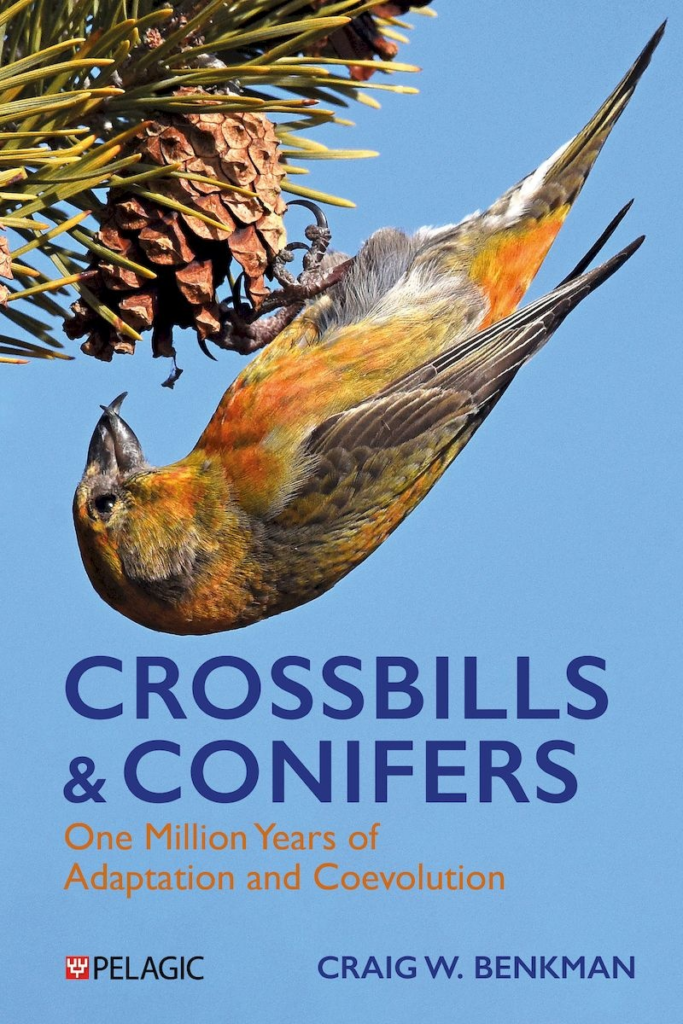
This book addresses how Crossbills (and their call types), especially the Cassia Crossbill, have coevolved using various conifer seeds in North America and the world. The core of Dr. Benkman’s research lies in the quantifiable relationship between the Crossbill’s bill and the structure of the conifer cones. Benkman discusses the early years when he was studying at SUNY-Albany and how he was able to measure foraging efficiencies in the field watching crossbills switch feeding on different conifers. During this same time-period he explains how Dr Jeffrey Groth was studying the vocalizations that lead to the description of the first eight crossbill call types. After the discovery of call types, Benkman’s research shifted to studying how some of the call types, and especially Cassia Crossbill, optimally forage on a presumed single key conifer seed resource. This has come to be known as the single ‘key conifer’ concept.
Much of Crossbills & Conifers spends time on the workings of this key conifer concept. While the different ecotypes (ecotypes = call types) can and do feed and breed in a variety of conifers, Benkman’s research explains they are closely matched to feed on their key conifer during the lean times of the year during late winter-early spring period. We address this last point more in detail below, but this hypothesis is run to the logical extreme in separating Cassia from Red Crossbills and thus elevating it to full species.
We also learn that some of the crossbill ecotypes, particularly Cassia Crossbill and conifers, are locked in a perpetual, reciprocal evolutionary arms race where the cones evolve features such as harder thicker scales to protect their seeds from the bird, while the crossbills evolve bill structures to counteract those defenses.
This leads to a thorough discussion of speciation and how the Cassia Crossbill evolved solely to exploit a local population of lodgepole pinecones in an area where the cone’s main seed predator, the red squirrel, is absent. This represents a compelling illustrationof how the removal of one factor can completely change the evolutionary trajectory of two others.
Craig really drives home the impact red squirrels have on cone availability in coniferous forests. Squirrels in fact, are much more important cone predators than crossbills. Much of the defenses the trees have developed are a result of co-evolution between squirrels and the cones that they extract seeds from across their ranges. Craig illustrates that forests without red squirrels give us a unique opportunity to study co-evolution between crossbills and conifers.
In North and Central America, there are at least 12 separate crossbill ecotypes. Evidence for these birds being specifically adapted to a particular conifer is presented for Cassia, White-winged and a few other ecotypes (namely 2,3,4,5, and 8). Type 10 has also been tied to Sitka spruce as its key conifer. It is worth noting that for types 1, 6, 7, and 12, no key conifers were discussed. While the evidence for Cassia and perhaps types 8 and 11 being tied to a key conifer is relatively strong, and well laid out, there remains questions about the strength to the degree that some of the ecotypes like 2,3,4 and 5 are tied to a single key conifer. Craig was specifically interested in the idea that it was morphology-dependent variation in foraging performance on key conifers that have reclosed in winter that best explains the evolution of the different types’ morphologies.
It is also worth noting that some potential key conifers were excluded from his research, and that many things besides crossbills’ bill morphology can affect their foraging performance on cones at a particular time, especially how many mature seeds are in the cones, the cone development stage, and whether the cones are closed or open. Even in Craig’s early studies in the Northeast, he showed that that crossbills switch conifer species they choose to forage on in the wild depending on which trees produced conifer cones with seed, and which ones produce the highest seed intake rates at the time.
We also note the book was published recently after the formal announcement of Type 12 (Northeastern) crossbill. This is unfortunate as it is one of the types that appears to best represent a ‘rich patch exploiter’ that regularly conifer switches, as would seem to be the best strategy in the northeast where conifer diversity is high, but density is low, rather than being adapted to any single conifer key conifer.
Beyond the discussion around cone feeding efficiency and speciation, Craig provides tons of fun information on flocking behavior, patch assessment, and evolution of calls. Chapter 6 provides us information on how crossbills can evaluate food crops by simply listening to other flock mates (public information) and how important having a “quorum” is in determining when to stay or move on.
The book presents a relatively compelling case for Cassia being elevated to full species and discusses in depth co-evolution between Cassia Crossbills and lodgepole pines in the red squirrel-free mountains of Cassia County, Idaho where the bird gets its name. And rather than being purely an academic dry data-based book, it is written in an easy-readable style, blending interesting natural history anecdotes with insights into evolutionary biology. Crossbills & Conifers offers birders far more than just a life history species account of a bird, it uses crossbills as a great example through which to explore the major themes of ecology, diversification, and evolution.
Dr Benkman devoted his scientific life (> 50 years!) to these birds, and his book Crossbills & Conifers: One Million Years of Adaption and Coevolution is a must-read for anyone that loves crossbills. While the title implies a focus on adaption and evolution, the book is also chock full of amusing anecdotes, details and also crossbill/conifer biology and ecology at a level of detail which greatly improves our understanding of the interactions of these birds. Dr. Benkman has always been an effective communicator with a great writing style. This is a fun read and we recommend it to anyone with an interest in finches, especially the wonderfully adapted crossbill.
Matt Young and Tim Spahr
Finch Research Network
Header photo: White-winged Crossbill (Loxia leucoptera) | GundegaProLife via Getty Images Pro / Pixabay
Suggested citation:
Young, M and T. Spahr. Review of the book Crossbills and Conifers: One Million Years of Adaptation and Coevolution. By Craig Benkman. Association of Field Ornithologists Book Review. https://afonet.org/2026/08/crossbills-and-conifers-one-million-years-of-adaptation-and-coevolution/
If you are interested in contributing a book review, or if there is a book you would like to see reviewed on our site, you can contact our Book Review Editor, Evan Jackson at evan.jackson@maine.edu