

We are glad to present this new section,
where for each new issue of the JFO, one of the journal’s
co-Editors-in-Chief will highlight their favorite paper.
This edition is courtesy of Dr. Rafael Rueda Hernández.
The selected paper was:
“Passive acoustic monitoring reveals the limited distribution of an indicator species, the White-headed Woodpecker (Leuconotopicus albolarvatus), in the northern Blue Mountains, USA” by Ferris, A. J., A. Duarte, J. Ratliff, and B. J. Vernasco. (2026, Issue 1, JFO).
Rafael says:
In this manuscript, I found many appealing aspects of what I envision as the future of field ornithology. The authors combined a fine-tuned fieldwork design, the implementation of technology, and state-of-the-art analytical tools to provide information on the relationships among the White-headed Woodpecker, habitat characteristics, and management practices.
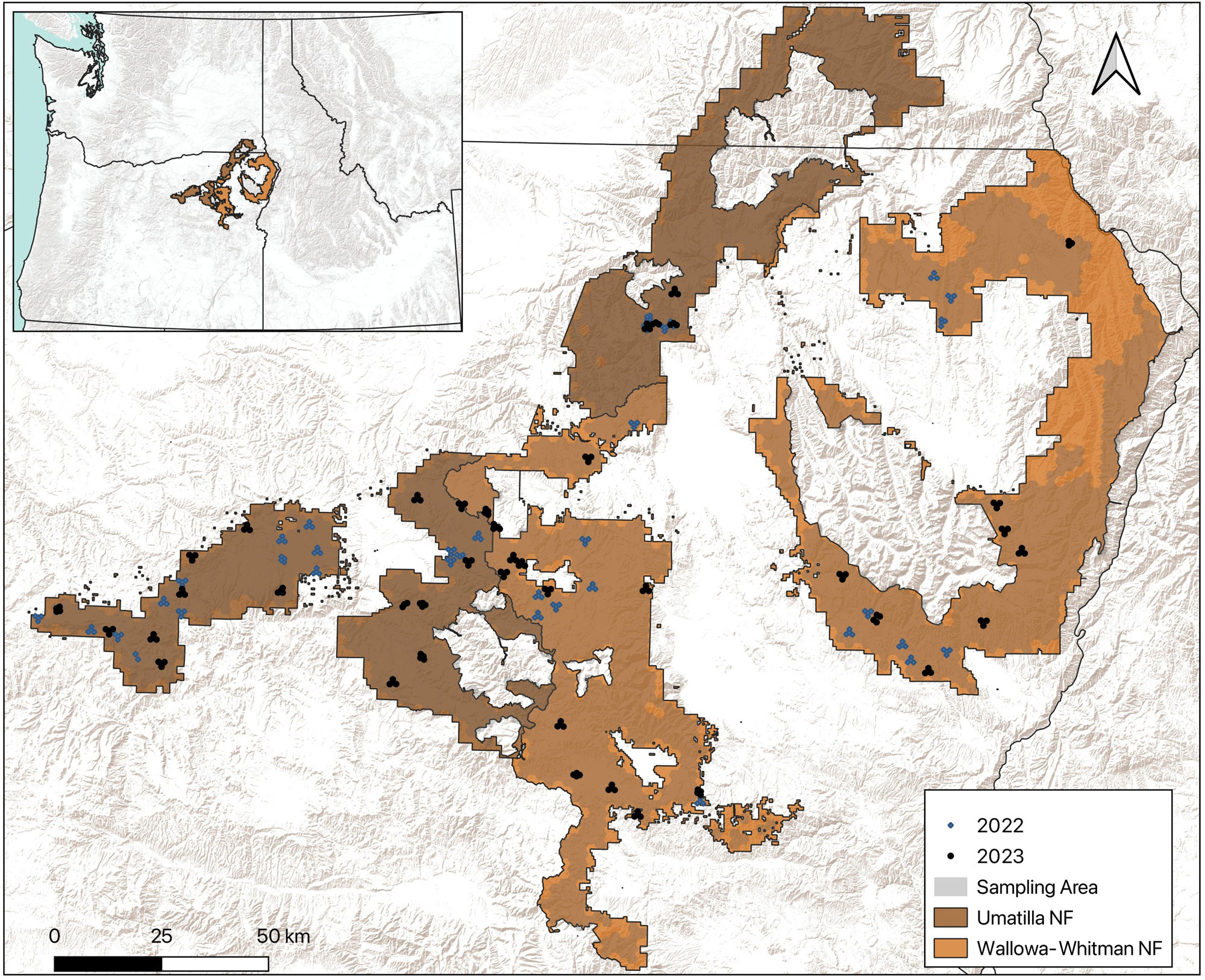
FIG 1: Map of the Umatilla (dark brown) and Wallowa-Whitman (light brown) National Forests. Black circles and blue diamonds indicate locations where recording units were deployed between 1 May and 31 June in 2022 and 2023. Shaded area within each national forest denotes the extent of the sampling area defined by amount of forested habitat and land ownership. Inset map shows the study area in relation to Oregon, Washington, and Idaho.
By simultaneously deploying dozens of automated recording units to sample a complex mountain system, the authors collected hundreds of hours of soundscape recordings. Then, using a combination of AI-based identification tools and supervised verification, they detected White-headed Woodpecker vocalizations and fed the data into occupancy and suitability models.
The results provide critical information, urge land managers and stakeholders to focus on improving habitat quality for this species, and highlight the importance and viability of monitoring indicator species using new approaches.
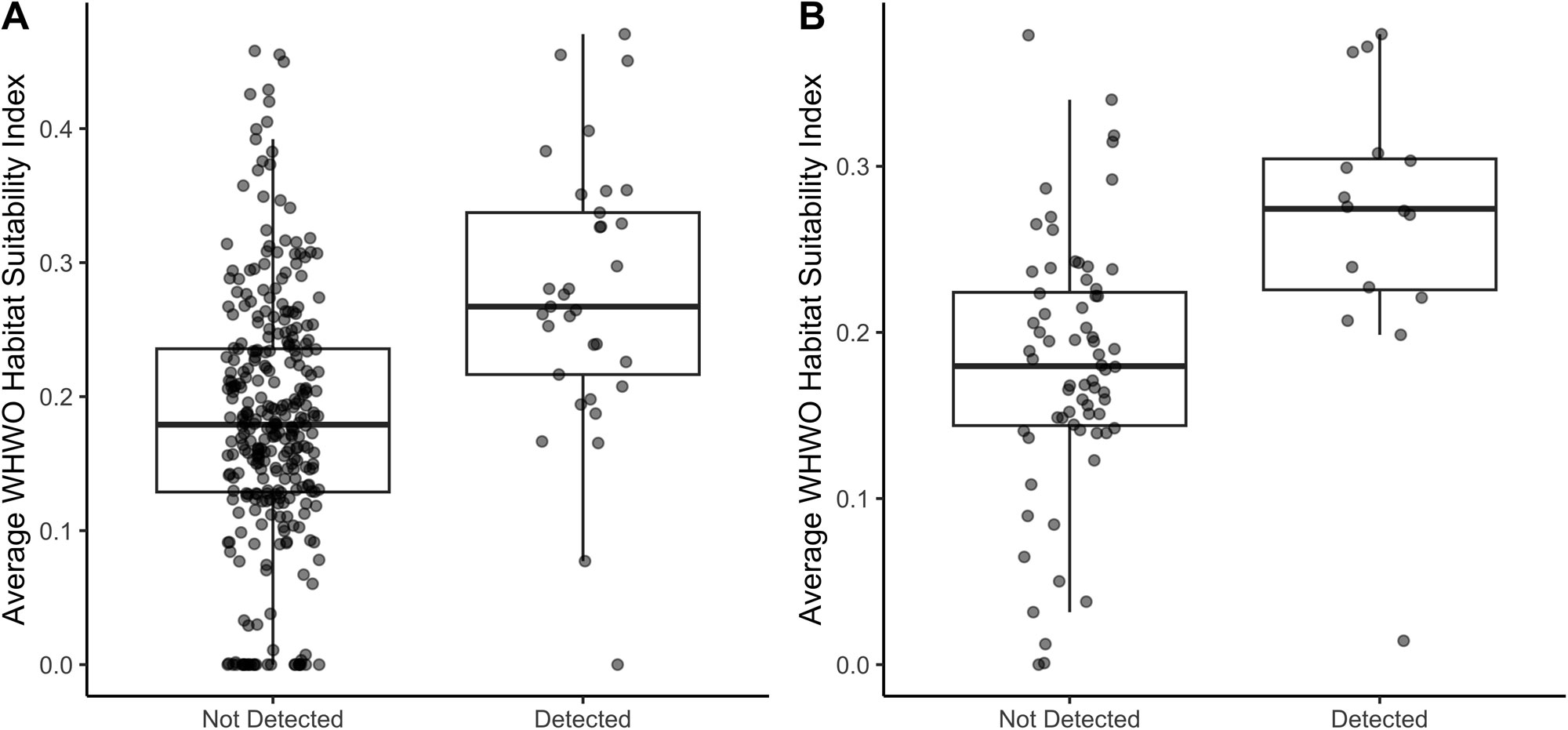
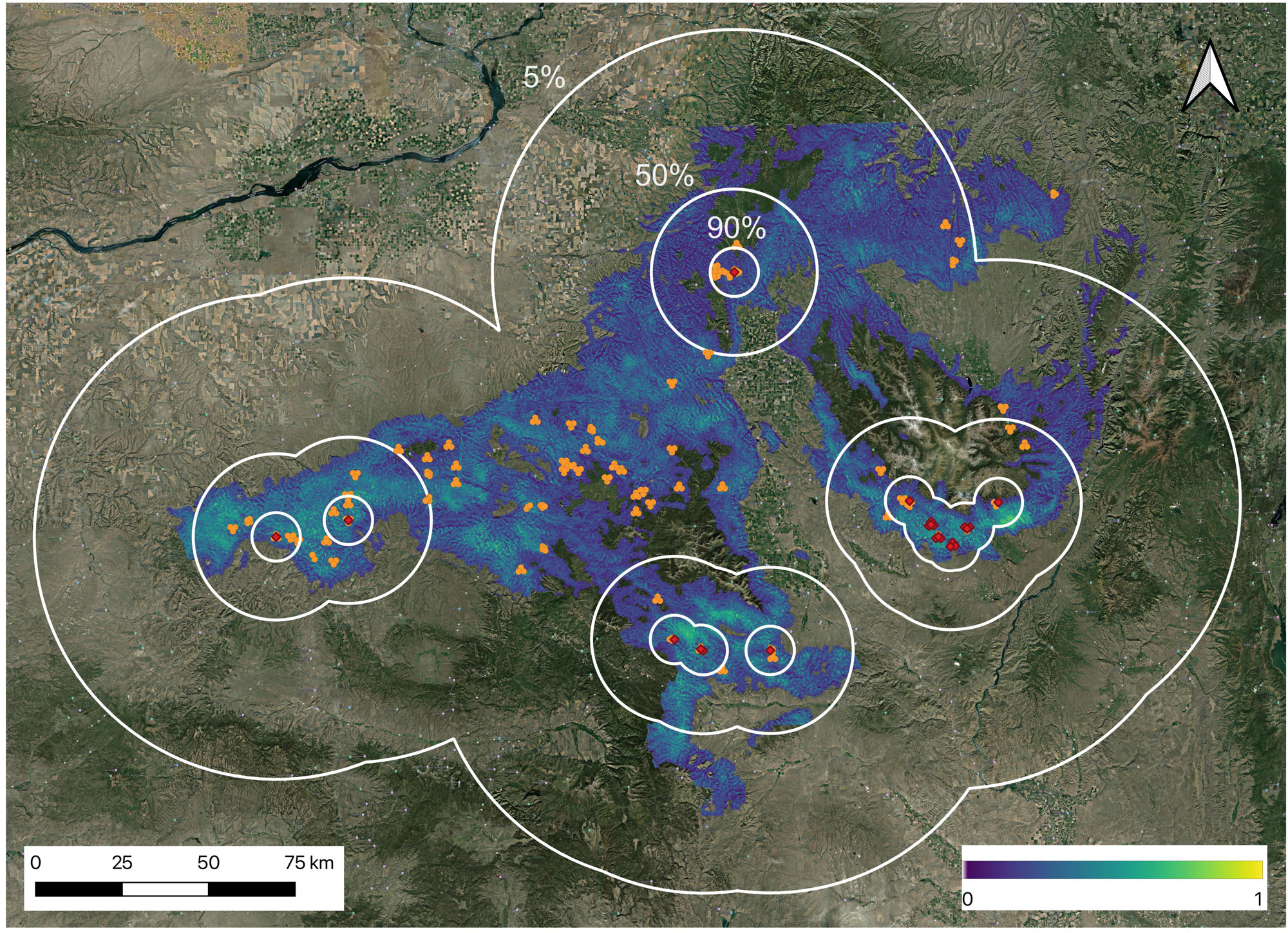
FIG. 3: Potential juvenile White-headed Woodpecker (Leuconotopicus albolarvatus) dispersal distances from areas found to be occupied by White-headed Woodpeckers. Red diamonds indicate stations occupied by White-headed Woodpeckers and orange circles indicate unoccupied stations. Blue to yellow gradient show the Habitat Suitability Index generated by Latif et al. (2015) on National Forest lands. The smallest white buffers indicate the minimum distance 90% of woodpeckers dispersed (i.e., 7 km radius), the middle white buffers indicate the minimum distance 50% of woodpeckers dispersed (i.e., 24km radius), and the largest white buffers show minimum distance 5% of juvenile woodpeckers dispersed (i.e., 70 km radius), as reported by Lorenz et al. (2024).
The results of this study were recently published in the Journal of Field Ornithology:
Ferris, A. J., A. Duarte, J. Ratliff, and B. J. Vernasco. 2026. Passive acoustic monitoring reveals the limited distribution of an indicator species, the White-headed Woodpecker (Leuconotopicus albolarvatus), in the northern Blue Mountains, USA. Journal of Field Ornithology 97(1):3. https://doi.org/10.5751/JFO-00736-970103