
Maine Bird Atlas 2018-2022. Adrienne J. Leppold, Glen H. Mittelhauser, Evan M. Adams, Douglas Hitchcox, Amy M. McLaughlin, and Logan A.M. Parker (eds.). 2026. The University of Maine Press. 744 pages. ISBN: 978-0-89101-144-6. Hard cover ($95)
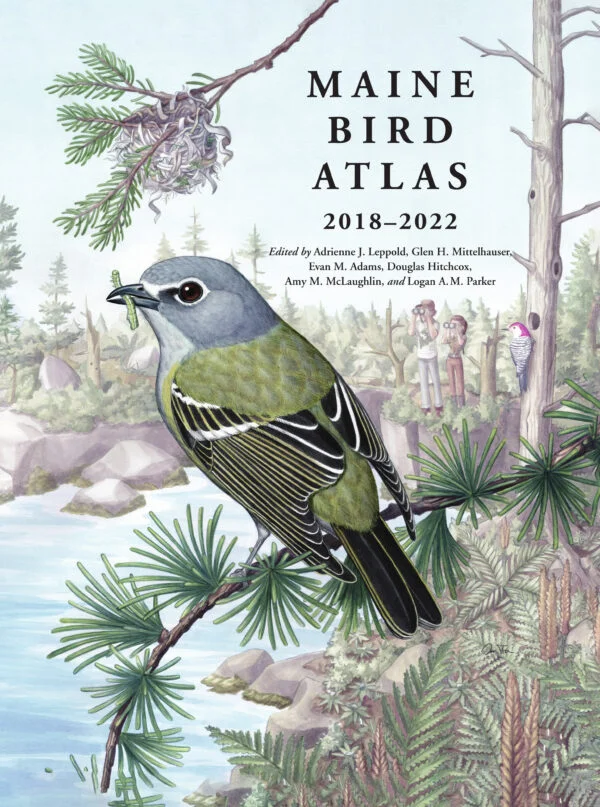
Ornithological atlases are multi-year projects that seek to map the distribution, and more recently, density and abundance of bird species within a defined area. To date, 60 states and provinces have completed at least one breeding bird atlas, and some (e.g., Maryland, New York, Ontario) have recently wrapped up their third atlas. These efforts have typically been repeated on a cycle of approximately 20 years, but given their incredible scope, delays can occur. Such was the case with Maine. As one of the first states in North America to conduct an atlas (1978-1983), an updated snapshot of the status of the state’s avifauna was long overdue. As far as winter bird atlas projects go, the number completed in the Americas can be counted on one hand. While Maine was not the first to complete a winter atlas, they were pioneers for running both efforts concurrently.
The Maine Bird Atlas 2018-2022 engaged more than 3,000 volunteers who contributed upwards of 100,000 effort hours. As with most printed atlas books, a list of volunteers is included in Appendix 5, and the eight-page wall of names gives a good indication of just how massive these projects can be. The scale alone creates interesting logistical challenges, but geographic location and topography can amplify those hurdles. Maine is without a doubt the most remote state in the eastern US. Not only does it have large expanses of contiguously forested habitat, but unique alpine and subalpine forests required specialized surveys to ensure adequate coverage. The complex and craggy coast and its more than 4,000
offshore islands are home to an interesting suite of coastal and pelagic species that are not only difficult to survey, but the waters can be especially treacherous during the winter period. Further, the COVID-19 pandemic occurred right in the middle of the atlas presenting unforeseen challenges but perhaps even some increased enthusiasm and participation in atlasing. The authors aptly describe all of this in the first paragraphs of the introduction as “ordinary people doing extraordinary things.”
Six introductory chapters cover everything from details about the history of the habitats within Maine, the study design and survey methods, data management, review and analysis, and a summary of the results and overall patterns of change. The information in these chapters covers quite a bit of ground, but in total makes up only about ten percent of the book. The individual species accounts–of which there are 332–comprise the bulk of this tome. Presumably, every documented hybrid and individual vagrant species (at least 50 vagrants) received an account, making this one of the most comprehensive collections of species accounts that a bird atlas has produced to date. Each account contains some background on the species’ natural history and overall distribution, its historical status within the state, a summary of results from both generations of their breeding atlas, results from winter surveys, and when applicable, a figure illustrating the bird’s nesting phenology. A series of full color maps, depending on the species’ seasonality, accompany the text. Owing to issues with effort affecting detection, raw block totals are not presented within the book; instead, the authors emphasize trends on maps, especially those of modeled occupancy and density. Finally, each account includes a “Look Back” inset box, that highlights an interesting description on the species’ statewide status from the earliest ornithological work in the state.
Spotlight stories are interspersed among the species accounts, and the authors describe their inclusion as an attempt to deepen the understanding of Maine’s avifauna. They synthesize conservation themes, unique habitats and bird behaviors, trends for irruptive species, and various human dimensions of the atlas. My favorite is Charles Whitney’s personal retrospective on his involvement with both of Maine’s bird atlases. His story highlights not only how far atlas projects have advanced but illustrates how intertwined our lives are with the birds we study. This atlas is as much about the people as it is the birds. The spotlight stories are a nice addition for the small number of readers who will consume the book linearly in its entirety, but the thoughtful stories may go overlooked by the many people who are likely to treat the atlas as a reference book, navigating to particular species accounts of interest. At times the spotlights felt a bit repetitive from the accounts which they are summarizing, but they add far more than a full-page photo may have in their place.
Who is the audience for these books? I would argue that it’s pretty broad, ranging from birders to researchers to future atlas coordinators. Given that broad range in interests and scientific understanding, it can be difficult to determine how many of the technical details to include. In many aspects of the book, the authors have taken a maximalist approach, which I feel is the better route. Details on the quantitative methods are extensive. Given all of the changes and advancements in atlas methodology in the four-decade gap between projects in Maine, the details are plentiful. Though, I’ve no doubt that the future coordinators and research associates of Maine’s third atlas will wish Leppold et al. had included even more.
Given the vast amount of material that this book contains, and the variation in content between species accounts, it can at times feel cramped and inconsistent. Some recently completed atlas projects have opted to present their findings with an interactive website, which can help alleviate some of the issues associated with the constrained layout of a book. However, while websites may provide more freedom and flexibility in how to present the material, their permanence is not guaranteed. These books are an important snapshot in time that are guaranteed to be a reference for generations to come. Every birder in Maine should have a copy on their shelf or coffee table, and the results presented here are relevant to researchers and land managers beyond the borders of the Pine Tree State. Incredibly, the first printing of 1,000 copies sold out on pre-order, but a second print run is in the works and expected to ship in early 2027
Matthew B. Shumar
Co-Director, Ohio Bird Atlas 3
Program Coordinator, Ohio Bird Conservation Initiative
The Ohio State University
Header photo: Blue-headed Vireo (Vireo solitarius) | BirdImages via Getty Images Pro / Pixabay
Suggested citation:
Shumar, Matthew B. Review of the book Maine Bird Atlas 2018-2022. By Adrienne J. Leppold, Glen H. Mittelhauser, Evan M. Adams, Douglas Hitchcox, Amy M. McLaughlin, and Logan A.M. Parker. Association of Field Ornithologists Book Review. https://afonet.org/2026/11/maine-bird-atlas-2018-2022/
If you are interested in contributing a book review, or if there is a book you would like to see reviewed on our site, you can contact our Book Review Editor, Evan Jackson at evan.jackson@maine.edu
Book Review Editor Evan Jackson was involved with data collection and species account authorship of several species in this project and publication. He did not influence or request edits to the review, only provided materials to the reviewer. He did not receive any monetary or promotional benefits from this review or publication.